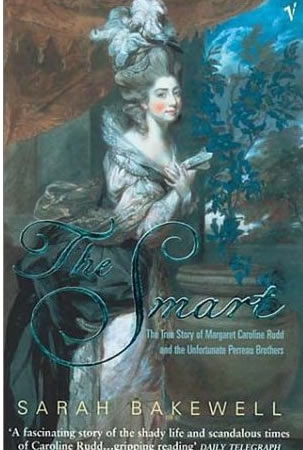
THE SMART

By Sarah Bakewell


The Smart cover


In forgery and perjury owned such art,
She palmed the Gold, while others paid the smart.

- William Combe, The Diabo-Lady (1777).


The Smart is a true drama of eighteenth-century life with a mercurial, charismatic heroine. Margaret Caroline Rudd was a young Irishwoman who ran off to marry a soldier, came to London, and slid into a glamorous life as a high-class prostitute. She was a risk-taker, and a seductress possessing mesmerizing appeal. 

In the early 1770s, she became involved with the Perreau twins, identical in looks but opposite in character.  One was a sober pharmacist, the other a raffish gambler and dandy – a “macaroni”, in the slang of the time.  The trio began forging promissory bonds or credit notes, living in luxury on the proceeds until the bubble burst and they were caught.  And forgery was a capital offence.

The Smart uses this incident to explore the world of eighteenth-century London. The  story of Margaret Caroline Rudd and the Perreau brothers is both a story profoundly of its period, and a wild ride through the universal themes of sex, money, death and fame.  It bridges the gap between aristocracy and underworld, as all levels of society became drawn into one of the greatest scandals of the age.

Chatto & Windus 2001. ISBN: 070117109X
Vintage paperback 2002. ISBN: 0099286637

Newsflash, August 2009: Unfortunately both editions are unavailable for a while - but the Vintage paperback will be reprinted in February 2010.


Read an excerpt

Read an excerpt


Reviewers said...

“Elegantly written, with a wry, deft touch, The Smart is the best kind of narrative history, broadly illuminating the period while it holds up a spotlight to the life of its enigmatic, seductive subject.”  The Sunday Times.

“A fair and often funny account of a charming lady criminal and her two unlucky sidekicks.”  The Daily Telegraph.

“Until Bakewell began her investigations, Caroline Rudd was a forgotten figure. Now she has become a vivid and immediate presence ... The Smart is a historically measured narrative, full of sharp pen-portraits, lively asides and quirky details.”  The Independent.

“Seemingly tireless research ... worn with admirable lightness in her rigorously detailed yet sparkily animated prose.”  Scotland on Sunday.

“Bakewell recounts a story of pain, betrayal, and the blackest kind of comedy with great skill.” The Independent on Sunday (paperback)


Back to top


Excerpt

James Boswell meets Margaret Caroline Rudd 1776

“He noticed that the light seemed to be hurting her eyes and moved the candles to a table further away from her. Then, however, he realized that he could not see the ‘pretty turns of her countenance’ as she talked, and he moved one of them back again, telling her flatteringly why he was doing it.

Mrs Rudd spoke about what she had learned in prison from the experience of solitude. She had chosen to sleep alone in her cell, declining the company of a maid. This was because she wished to spend the time in spiritual reflection. ‘I hope I shall be the better for it,’ she told Boswell. ‘I hope I am wiser.’

‘When you speak of insensibility and of solitude,’ said Boswell jokingly, ‘you might as well be a nun.’

‘Oh yes,’ said Mrs Rudd. ‘If it were not for my children I would retire to a convent.’ But in fact, she admitted, she could not bring herself to retreat from the world altogether.

People told many stories about her, she went on. For example, they were now saying that she lived with Lord Lyttelton, although she did not even recognize the man by sight. ‘Besides, Lord Lyttelton is not a person with whom one would form a connexion, as he is quite a profligate.’

That wasn’t all, said Boswell. ‘I heard today that you and the Earl of Loudoun were very well acquainted.’

‘To be sure,’ said Mrs Rudd, ‘if the Earl of Loudoun were to come into this room, I should know him; but as to any intimacy …’

‘It is amazing with what confidence people will tell lies,’ said Boswell. ‘But there is a vanity in being thought to know particularly about a lady so celebrated as you.’

‘People are apt to form an idea of one whom they have never seen. A gentleman told me he had imagined that I was old and ugly!’

‘Why,” said Boswell merrily, ‘that was very extraordinary, though indeed it may have been owing to the reputation of your enchantment, as witches were said to be old and ugly. You are, however, much younger than I supposed.’

‘But I am not a young woman,’ she said, ‘I am nine-and-twenty, and I do not think that young.’  In fact she was thirty-one.

As she spoke Boswell noticed that ‘a pretty little foot’ had become visible, and the combination of this sight with the tale of her sufferings excited him. He rose out of his chair, saying, ‘I cannot believe that you have gone through all this. Are you really Mrs Rudd?’

She smiled. ‘I am Mrs Rudd.’


Back to top

Home Exhibitions Writing Courses Blog